My Experience with Killing Time
There's a small secondhand bookstore in my town that operates in a constant state of disarray. Located in a retail plaza in between a Chinese takeout place and a liquor store, it's musty and cramped, its shelves overstuffed with books just as likely to be apparently misshelved as they are to be in any recognizable order. The owner of the shop is a gruff and elderly man who only takes cash, and I can't go there too often, because it overwhelms me. I fear that I'll spend hours lost in scrutinizing the shelves in case I missed something—and no matter how much time I dedicate to the task, I just know there will be a rare book I've been searching for tucked away in a corner somewhere just out of my sight. It's stressful. I have to self-impose preset limits like "I am only browsing the science fiction section today and then I'm leaving" for the sake of my mental health.
It was as I was doing just that on a recent visit that a certain title caught my eye. I consulted a screenshot of a Fanlore page on my phone as I slid it off the shelf and flipped to a specific page number, trying not to get my hopes up too much. "Yeah, this isn't it," I remarked to my husband as I read. "A couple sentences are missing."
He responded by pointing to another nearby shelf. "Isn't that another copy of the same book?"
My heart pounded as I thumbed through the second copy to the same page, and my eyes fell on the words, "I understand that you were probably playing with dolls and wearing lipstick until you were twenty!" I gasped. This one was really it. I had found an uncensored first edition of Della Van Hise's 1985 novel Killing Time.
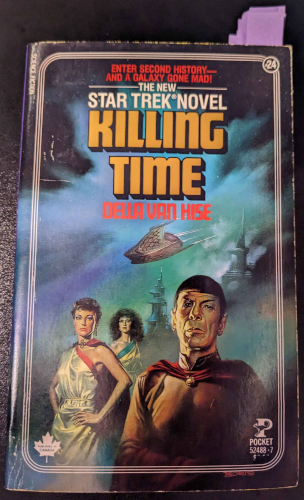
Pictured here is my actual copy, with sticky notes I added as I read to all the gayest pages.1
A collector's item to a certain subset of Star Trek fans since shortly after its release, Killing Time is known for being suffused with romantic subtext between Kirk and Spock that would later be excised from subsequent editions. Comments from the author indicate that this occurred because of some genuine miscommunication over the edits the publishers wanted made to the final manuscript, and not because she was trying to pull one over on them intentionally; she maintained that while she had written Kirk/Spock fanfiction in the past, she didn't feel that her novel contained any more homoerotic undertones than canon did already. Nevertheless, Pocket Books does seem to have had a certain agenda with the text they chose to remove in the second edition, toning down a lot of the closeness of the relationship depicted between the two leads.
The story of Killing Time begins with what should be a routine patrol of the border to the Romulan Neutral Zone—during which many of the crew of the Enterprise begin suffering from disturbing dreams. Soon after, they wake up to find themselves leading alternate lives in another universe, where Spock is captain of the VSS ShiKahr, and Kirk is just a troubled young ensign under his command. At first, they don't consciously remember that anything changed, but they share a sense that something isn't right. As they begin to investigate and come to terms with the idea that they might have somehow shifted to a less favourable timeline, there's a lot of emphasis on the importance of Kirk and Spock's relationship in the world they came from, and how important it is to set that right. A deeply erotic mind meld helps Kirk recover some of his suppressed memories of the life he's supposed to be leading, and he and Spock set off to find a way back to where they came from before they get stuck in these alternate lives permanently.
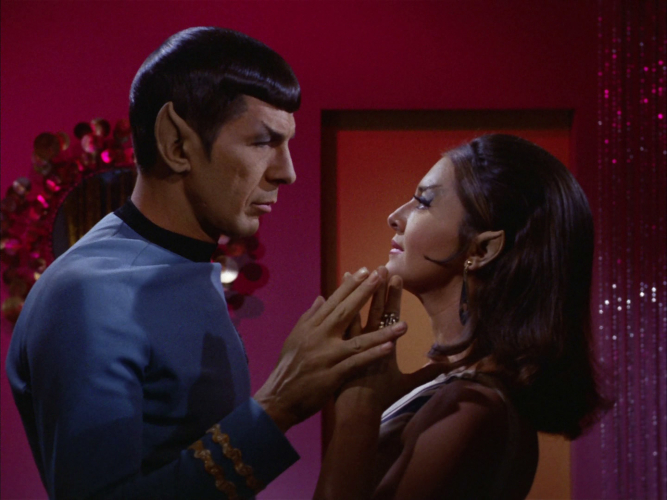
Like the last Star Trek book I reviewed on this site, Killing Time also gives an important role to the Romulan commander from the episode "The Enterprise Incident," here named Thea and promoted to praetor of the whole Romulan Empire. I guess it's not surprising that she'd have been a popular character with female fans, as she's one of the most powerful women you ever see in the original series—not to mention that she gets to do some hand kink stuff with Spock. Killing Time takes that to the next level and gets her to help Spock with pon farr this time, because of course she does. That occurs when Spock ends up needing to join forces with some Romulans to correct the timeline, which is unfortunately the part of the plot that was the least interesting to me, in comparison to Kirk and Spock's earlier interactions establishing the differences in the alternate universe aboard the ShiKahr. But once that's taken care of, the book closes things strong with another erotic mind meld and some wedding ring imagery, so all's well that ends well.
A Livejournal user going by the name lexx_the_flex put together a comprehensive comparison between the first and second editions of the book in 2009, which provides a lot of insight into which parts of the book seem to have been deemed too queer to be officially associated with the Star Trek franchise at the time of publication. From the very first deletions in the early pages of the novel, you can see a pattern to what gets removed: it's a lot of descriptions of physical closeness between Kirk and Spock, as well as references to the common fan interpretation that Spock's telepathic abilities may mean the two can sense aspects of each other's thoughts and feelings. Especially interesting to me in combination with that is the line cut from page 41 that I used to double check which edition I was holding in the bookstore—the one about "playing with dolls and wearing lipstick." Unlike so many of the others, it's not homoerotic, but homophobic; the more aggressive version of Kirk in the alternate universe there is insulting another man by calling him effeminate. And the scene doesn't really make sense without it, because in the original version this insult provokes the guy into punching Kirk next, and in the second edition he still punches him, but for kinda no reason. It's like the editors went way too overboard making sure they cut out any possible implication of homosexuality, even one that paints it in a negative light, without much concern for whether what's left behind without those lines works on its own at all.
There are also some shirtless scenes in the first edition, for which the editors essentially put the shirts back on by cutting out all the description that referred to it. Then we start to get to some much heavier edits, with whole paragraphs missing from later editions, about halfway through—at the point when we're getting into erotic mind meld territory. Here lexx_the_flex's comparison also indicates that some lines were not just removed but replaced with tamer versions, such as "he allowed his hand to come to rest on the side of the warm human face" in the original becoming the much less descriptive "he initiated the mind meld." Amusingly, they also cut out Kirk saying the word "bullshit," a casual reference to alcoholism, and one or two mildly sexual jokes, including one referring to Spock's little pon farr liaison with Thea. So it wasn't just the homoerotic subtext—there seems to have been an overall effort to tone down mature content in general—but the vast majority of what was cut in the second edition has to do with Kirk and Spock touching each other and penetrating each other's minds.
What I'm surprised to find wasn't edited at all was either of the little moments I read as potentially implying attraction between women—a scene in which Christine Chapel has a cute little sparring match with a furry alien girl who calls her "Chris," and a deeply charged interaction between Thea and another Romulan woman that involves her offering to share one of her male sex slaves. Maybe the editors were so distracted trying desperately to remove any hint of M/M slash that they accidentally left in all the bisexual women—or maybe I'm just so shipper-brained that I'm saying "oh they fuckin'" to any two characters interacting at all.
Either way, I really enjoyed Killing Time, and I'm glad I had the chance to experience this little piece of Star Trek history. I have a lot of the respect for the efforts early Kirk/Spock shippers made to get their work and their interpretation of the characters they loved out there, despite the hostility they sometimes faced. I think the increasing amount of fanfic authors who are finding success in the traditional publishing world today owe some of that gradual shift in attitudes to Della Van Hise and to other writers like her. The first edition of Killing Time is a landmark in the history of fanfiction, and it's also a fun read with some wild twists and turns. Keep an eye out for it the next time you're in a secondhand bookstore, and double check page 41 for that lipstick line if you do, to make sure you get the full experience of the Star Trek story that was so gay it got censored by the publishers. You really won't want to a miss a line of those mind meld scenes.
Works Cited and Consulted
Van Hise, Della. Killing Time. Pocket Books, 1985.
Killing Time (Star Trek tie-in novel) on Fanlore
lexx_the_flex., "Homoerotic Star Trek Novel 'Killing Time' - uncensored vs. censored." Livejournal, 28 September 2009.
ProZD, "shipping characters." YouTube, 21 May 2018.
TrekCore's screenshots of The Enterprise Incident
And my own previous post about The Price of the Phoenix
1. Many sources will tell you the first edition is supposed to have raised text for the title, but as the little maple leaf in the bottom left corner indicates, this is actually a Canadian first edition, which is a tiny bit different!